
I grew up around air hoses snaking across shop floors, and for a long time I treated a pneumatic framing nailer like the default setting for building anything that mattered. Then cordless nailers got good. Not gimmicky good, but jobsite good. Now the question is not “which is better?” It is “which one fits how you actually build?”
This breakdown is how I think about it on real framing days, when you are moving fast, chasing plumb, and trying not to turn your floor into a spaghetti bowl of hoses and cords.
The quick answer
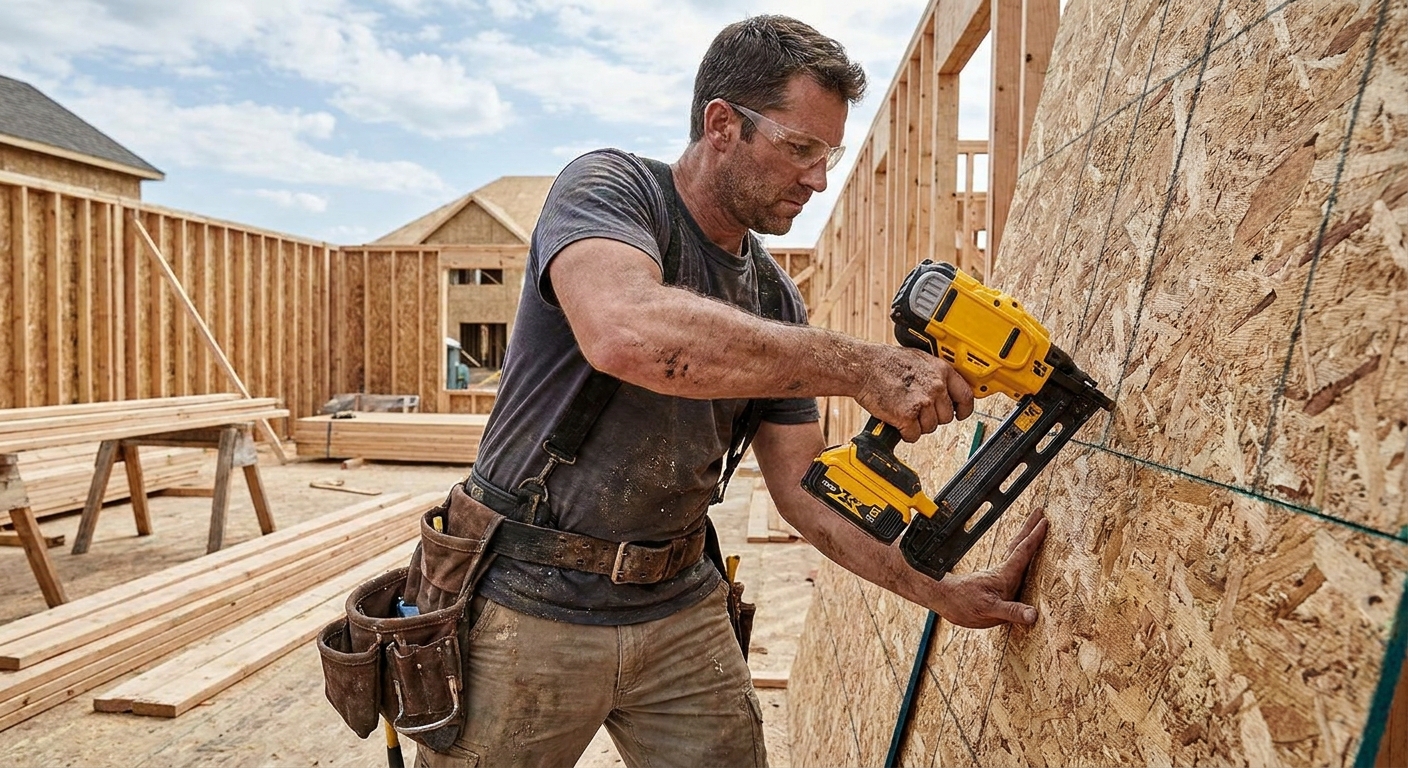
Choose pneumatic if you want the lightest tool in your hand, an often lower operating cost, and the most consistent sustained speed for production framing.
Choose cordless if you value mobility, quick setup, and working in spots where dragging a hose or compressor is a pain, like punch lists, remodel framing, decks, shed builds, and small crews moving constantly.
If you frame for a living, a common sweet spot is owning both: pneumatic for the big push, cordless for everything that feels like a “few walls” that turns into half a day.
How each system works
Pneumatic framing nailer
A pneumatic gun is basically a fast air-driven piston. Compressed air does the work. The gun itself can be simple, light, and brutally consistent, but it needs a compressor, hose, fittings, and enough air volume to keep up.
Cordless framing nailer
“Cordless” can mean a few different things. Most battery-only cordless framing nailers today use one of two main drive styles:
- Flywheel (spins up, then drives the nail). Often fast cycling and can feel a little “bumpy” until you get used to it.
- Gasless spring or sealed nitrogen style (varies by brand). Often feels closer to pneumatic at the nose.
There is also a third category you will still see on job sites: battery plus a fuel cell (Paslode-style). They work, they are proven, and they hit hard, but you are buying fuel cells as you go, and that changes the real cost and logistics.
Either way, cordless guns are heavier and more complex, but they carry their own “compressor” with them, which is the whole point.
Pros and cons: cordless
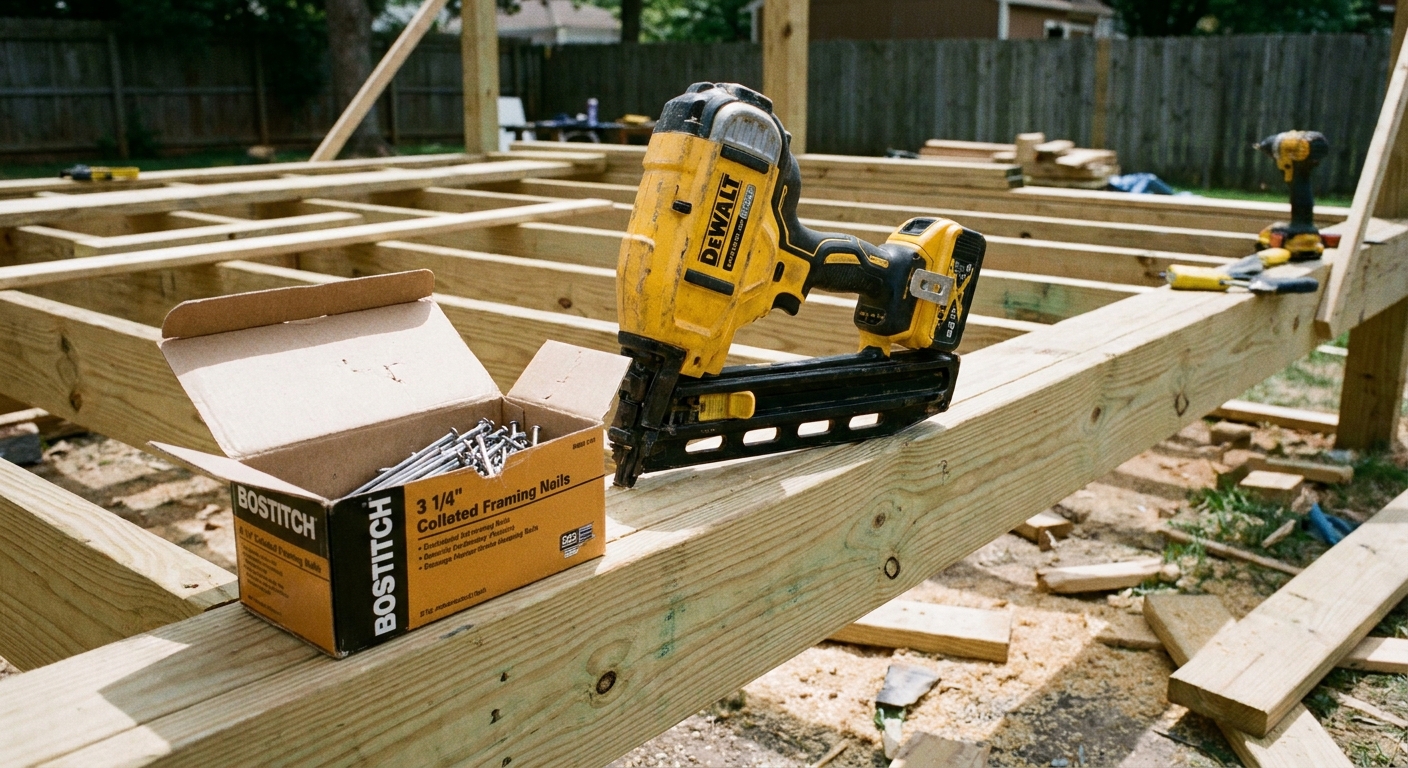
Where cordless shines
- Almost zero setup: grab it, load nails, go. That matters when you are only driving 60 nails, not 6,000.
- Mobility: no hose to snag on joists, ladders, or scaffold wheels.
- Cleaner, quieter workflow: no compressor cycling on and off, no hose whip, fewer trip hazards.
- Great for remodels and tight sites: occupied homes, stairs, attics, and anywhere a hose becomes a liability.
- One-person efficiency: if you are solo building a shed or setting a few headers, cordless can feel like cheating.
The trade-offs
- Weight: most cordless framing nailers are noticeably heavier than pneumatic. Overhead work and ladder work can get old fast.
- Cycle speed and rhythm: modern cordless is plenty fast, but in most production situations pneumatic still has the edge for relentless bump firing and that steady cadence.
- Battery and fuel logistics: batteries need charging, cold weather performance drops, and if you run a fuel cell model you have another consumable to keep stocked.
- Maintenance and durability: more electronics and moving parts means more to go wrong if the tool lives a hard life.
- Cost: the upfront buy-in is usually higher, especially once you include extra batteries and a charger if you are not already on that platform.
- Jam clearing downtime: cordless guns can take a little longer to open up and reset depending on the design. Not a deal breaker, but it is real when you are on a ladder and the gun decides to be picky.
My practical note: if you are sheathing a whole house and you plan to run hard all day, the cordless gun may do it, but you will feel it in your forearm and in your battery pile.
Pros and cons: pneumatic
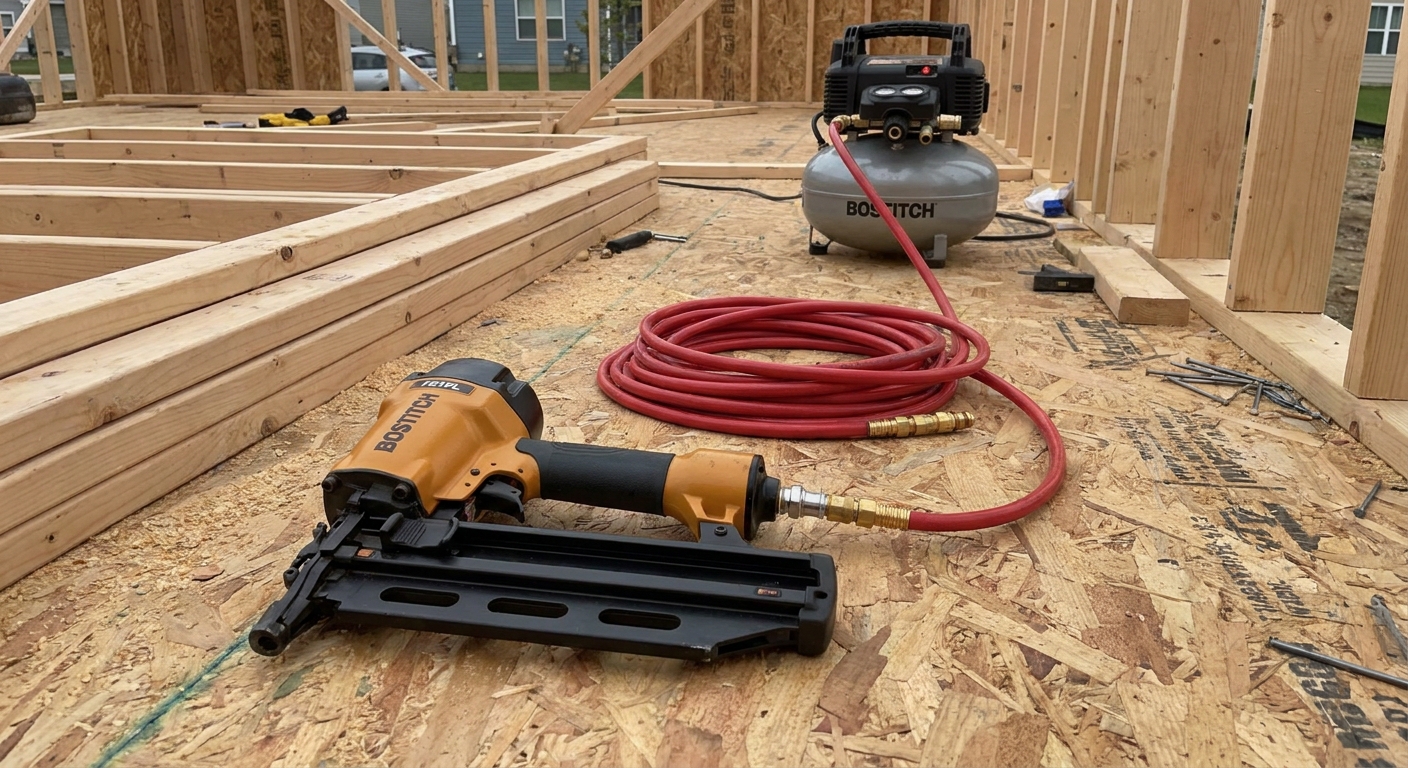
Where pneumatic shines
- Power to weight is excellent: the gun can be lighter because the compressor does the heavy lifting.
- High sustained production: framing walls, shooting sheathing, nailing off subfloor, running all day without thinking about batteries.
- Lower tool cost: you can often buy a solid pneumatic nailer for less than a cordless kit.
- Consistency in cold weather: no battery sag. As long as the compressor is happy and moisture is managed, it just runs.
- Simple serviceability: seals, drivers, and O rings are known territory, and parts are often easy to source.
The trade-offs
- Setup and teardown: compressor out, hose run, power found, fittings checked, pressure set.
- Hose management: hoses snag on joists, drag through mud, knock over stacks, and find every sharp edge you forgot existed.
- Noise: compressors are not quiet. In neighborhoods or interior remodel work, they can be a constant irritation.
- Moisture and winter quirks: water in the line, frozen fittings, and pressure changes can cause misfires if you are not on top of your system.
- Jobsite footprint: the compressor and hose take space, and space is always what you are short on.
- Jam clearing: pneumatics vary. Some clear fast, some are a knuckle buster. The upside is you are not waiting on electronics to reset.
My practical note: if you are working with a crew, air makes a lot of sense. One compressor can support multiple guns if it is sized correctly for the CFM demand and you run clean hose and regulators.
Real job site use cases
New construction framing days
If we are standing walls, running plates, or sheathing all day, I like pneumatic. The gun stays lighter, the cycle stays consistent, and I am not thinking about batteries while I am trying to keep corners square.
Decks, sheds, and backyard builds
For outdoor work where you are moving around the site constantly, cordless earns its keep. No dragging a hose through gravel, mud, or landscaping.
Remodel framing and punch lists
This is cordless territory. When you are adding blocking, adjusting a doorway, building a small partition, or fixing something behind drywall, the fastest tool is the one that is already in your hand.
Roof work and ladders
This depends on your comfort and the exact tool, but weight matters up high. A lighter pneumatic gun can be easier on your body, but hoses on roofs also create trip hazards. If I go cordless on a roof, I want a predictable contact tip, and I keep my footing and staging conservative.
Interior occupied homes
Often cordless wins simply because it keeps the environment calmer. Less noise, less hose drag, less bumping trim and drywall corners with a hose coupler.
What to compare
1) Nail compatibility
Not every gun likes every nail. Pay attention to nail angle (common angles are 21 degree plastic collated and 30 to 34 degree paper tape), shank type (smooth, ring, screw), and length range. The “best” nailer is the one that runs the nails you can reliably get in your area.
2) Head style and inspection
This is the one people ignore until an inspector forces the conversation. Some regions and some engineers prefer or require full round head nails for certain structural connections, while clipped head nails can be restricted depending on local code and the exact application. Before you commit to a gun and an angle, make sure the nail head style you plan to use matches what your local inspection culture expects.
3) Depth of drive control
Depth adjustment that is quick and repeatable matters more than people admit. Framing is not one material. You move from SPF to LVL to hangers to sheathing and back again. Whether pneumatic or cordless, you want a depth control you can change without fighting the tool.
4) Sequential vs bump fire
Some jobs call for sequential (safer and more precise), others benefit from bump fire (fast sheathing and production nailing). If speed is your world, make sure the mode you want is available and easy to switch.
5) Cold weather performance
In the Pacific Northwest, winter framing is real. Batteries lose punch in the cold, and air systems can collect moisture. If you routinely work below freezing, plan for it: spare batteries kept warm for cordless, and good moisture management for air.
6) Service and parts
A framing nailer is a money tool. Look into how easy it is to get parts and service in your area. For pneumatic, seal kits are common. For cordless, the question is often whether the platform and service network is strong for the long haul.
If you want a broader look at tool selection and jobsite fundamentals, I keep the main reference pages organized in the Tools guide.
Cost: what people miss
Cordless total cost
- Tool body
- Batteries (realistically at least two if you work steadily)
- Charger
- Battery platform commitment across your other tools
- Fuel cells, if you buy a fuel cell style nailer
Pneumatic total cost
- Gun
- Compressor with enough CFM to keep up
- Hoses, couplers, fittings, and repairs over time
- Power source and extension cords when needed
Also, nail cost is not one clean number. Plastic collated vs paper tape, regional availability, and brand all change it. Pneumatic often comes out cheaper over time, but it is worth doing the math with the nails you will actually buy.
On paper, one pneumatic gun can look cheap. On an actual jobsite, the compressor system is part of the purchase whether you buy it today or “borrow it for now.”
Maintenance basics
- Pneumatic oiling: some guns want a couple drops of air tool oil, others are designed to run oil free. Read what your nailer calls for and stick to it. Wrong oil habits can swell seals or just make a mess.
- Moisture management: drain the compressor tank, and if you run air hard, a simple filter regulator and water separator can save you a lot of weird misfires.
- Keep nails clean and correct: both systems hate bent strips, bargain nails with inconsistent collation, and the wrong angle.
Safety and workflow notes
- Hoses are trip hazards: route them intentionally, especially around stairs, ladders, and cut stations.
- Keep your off hand honest: cordless or pneumatic, nails do not care about your fingers. Clamp small pieces and keep hands out of the line of fire.
- Wear hearing and eye protection: compressors add noise, but even cordless nailers are loud in enclosed spaces.
- Check for overdrive: burying nails too deep can weaken connections, especially in sheathing and hardware. Set depth for the material, not for ego.
Good framing is more than a fast trigger finger. It is layout, sequence, and keeping things square. If you are building systems and want a refresher on fundamentals, start at the Framing guide.
My decision checklist
If you are stuck, answer these honestly:
- Am I doing all day production work? If yes, pneumatic usually wins.
- Am I constantly moving rooms, levels, or sites? If yes, cordless usually wins.
- Do I already own batteries on a tool platform I trust? If yes, cordless gets more attractive.
- Do I already own a compressor that can keep up? If yes, pneumatic gets cheaper fast.
- Is ladder and overhead work a big part of this? If yes, pay extra attention to weight and balance.
- Do I need full round head nails for my area or plans? If yes, choose a gun that runs them without drama.
For a lot of builders, the most realistic “best” answer is: cordless for mobility and small runs, pneumatic for the long nailing days. If you pick the one that matches your typical day, you will be happier than chasing specs.
FAQ
Is cordless strong enough for LVL and engineered lumber?
Most modern cordless framing nailers have plenty of power for typical framing and engineered lumber, but performance depends on nail choice, material density, and battery condition. If you routinely drive long nails into dense stock all day, pneumatic is still the most consistent.
Do pneumatic nailers jam less?
In my experience, a well maintained pneumatic gun with clean, correct nails tends to be very consistent. Cordless nailers can also be reliable, but they are more sensitive to nail strip quality and battery state. Either system will punish you if you feed it the wrong nails.
Can I frame a whole house with a cordless nailer?
Yes. People do it. The bigger questions are comfort, speed, and battery or fuel logistics. If you are solo and value simplicity, cordless can carry a lot. If you are in production mode, pneumatic is usually the smoother path.